




Ergonomic Seating Guide
Fit, support, and motion features—how to choose seating that supports your body for the long haul.
Comfort That Fits Your Body
Ergonomic seating isn’t about ‘puffy soft’—it’s about engineered support that moves with you. This guide helps you understand fit fundamentals, why sizing matters, how motion features work, and what to look for in warranty and serviceability.
Use the tabs below to self-diagnose your comfort needs, then explore our recommended brands at the bottom.
What to Know
Finding the Right Fit
Ergonomic seating starts with fit, not features. The most advanced recliner in the world won’t help if it’s the wrong size for your body. Here’s what to evaluate:
- Seat height: Your feet should rest flat on the floor with your thighs roughly parallel to the ground. Too high and your legs dangle; too low and your knees push up, straining your hips.
- Seat depth: Sit all the way back—there should be 2–3 inches of space between the front edge of the seat and the back of your knees. Too deep and you’ll slouch; too shallow and you won’t get enough thigh support.
- Lumbar support: The chair should support the natural curve of your lower back. If you feel a gap between your lower back and the chair, the lumbar isn’t engaging. Adjustable lumbar is a significant advantage.
- Head and neck support: If you read, watch TV, or nap in the chair, head/neck support matters. Look for headrests that adjust in angle and height—not just one fixed position.
Key Takeaway: Fit comes before features. Match your body to the right size first, then evaluate features.
Ask us: “Can I sit in this for 10 minutes before I decide?” A real test in your normal positions tells you more than any spec sheet.
If a brand offers small, medium, and large—pay attention. Size designations exist because bodies vary, and a chair that fits a 5’6” person won’t fit a 5’2” person the same way.
Why sizing matters:
- Brands like Stressless offer distinct sizes for many of their recliner models. The internal dimensions (seat depth, width, back height) change with each size—it’s not just a visual scaling.
- Choosing the wrong size means the lumbar hits the wrong spot, the headrest is too high or low, and the seat depth doesn’t support your thighs properly.
How to measure yourself:
- Note your height and weight as starting points.
- Measure from the back of your hip to the back of your knee (seated)—this is your ideal seat depth.
- Measure from the floor to the crease behind your knee—this is your ideal seat height.
Key Takeaway: Try multiple sizes in the showroom back to back. The difference is immediately obvious when you sit in the wrong size first, then switch to the right one.
Ask us: “Which size is right for my height and build?” We’ll measure and recommend before you even sit down.
Motion seating can be a game-changer for reading, TV, and back support. But not all motion mechanisms are equal, and there are practical considerations beyond comfort.
Types of motion:
- Glide/swivel: Allows the chair to rotate and rock gently. Great for conversation areas and multi-use rooms. Stressless’s patented Glide system is designed to move with you as you shift position.
- Manual recline: You control the recline angle with body pressure or a lever. No power source needed. Simpler mechanism means less to maintain.
- Power recline: Motor-driven for precise adjustment. Often includes power headrest and lumbar. Requires a power outlet nearby.
Practical considerations:
- Wall clearance: Many recliners need 4–6 inches of clearance behind them. Some ‘wall-hugger’ designs need less. Measure before you commit.
- Power access: If choosing power recline, confirm outlet locations. Running a cord across the room defeats the purpose of a clean setup.
- Weight capacity: Confirm the mechanism’s rated capacity, especially for larger frames.
Key Takeaway: Check wall clearance and power access before committing to any motion piece.
Ask us: “What wall clearance does this model need, and where should I place the power outlet?”
If you’re experiencing discomfort in your current seating, here’s what usually fixes it:
- “My lower back hurts after sitting.” → The lumbar support isn’t in the right spot, or there’s no lumbar support at all. Look for adjustable lumbar or a chair sized so the curve hits your lower back naturally.
- “My legs go numb.” → The seat is too deep or too high. Your weight is pressing on the back of your thighs instead of distributing evenly. Try a shallower seat or a lower seat height.
- “My neck and shoulders ache.” → The headrest is either too high, too low, or missing entirely. An adjustable headrest that supports the base of your skull can make a dramatic difference.
- “The chair felt great in the store but not at home.” → You may have sat in it for 2 minutes in the showroom. Spend 10+ minutes in your actual sitting positions (reading, TV, resting) before deciding.
- “I can’t get in or out easily.” → Seat height is likely too low. Higher seat heights are easier on knees and hips. Power-lift mechanisms are available for those who need assistance.
Key Takeaway: Most comfort problems trace back to wrong sizing, not wrong features. Fix the fit first.
Ask us: “I’m having [specific problem] with my current chair—what should I look for?” We diagnose comfort issues every day.
Ergonomic seating has more moving parts than stationary furniture. That makes warranty and serviceability especially important.
Your serviceability checklist:
- Mechanism warranty: How long is the internal mechanism covered? Stressless, for example, references a 10-year guarantee on internal mechanism/construction and framework components including metal springs.
- Frame warranty: Separate from the mechanism—covers the structural shell of the chair.
- Upholstery/leather: Typically a shorter warranty and tied to proper care. Ask what’s considered ‘normal wear’ vs. a covered defect.
- Parts availability: Can individual components be replaced? Cushions, headrests, and mechanism parts should be serviceable without replacing the entire chair.
- Local service: Is there a service network for repairs? Can the dealer (us) handle warranty claims directly?
Questions to ask before you buy:
- “What’s covered under warranty, and for how long?”
- “If the mechanism fails in year 5, what happens?”
- “Can I order replacement cushions or covers later?”
Key Takeaway: Look for replaceable/serviceable parts and a dealer who handles warranty claims directly.
Braden’s tip: We handle warranty coordination with the manufacturer so you’re not chasing paperwork.
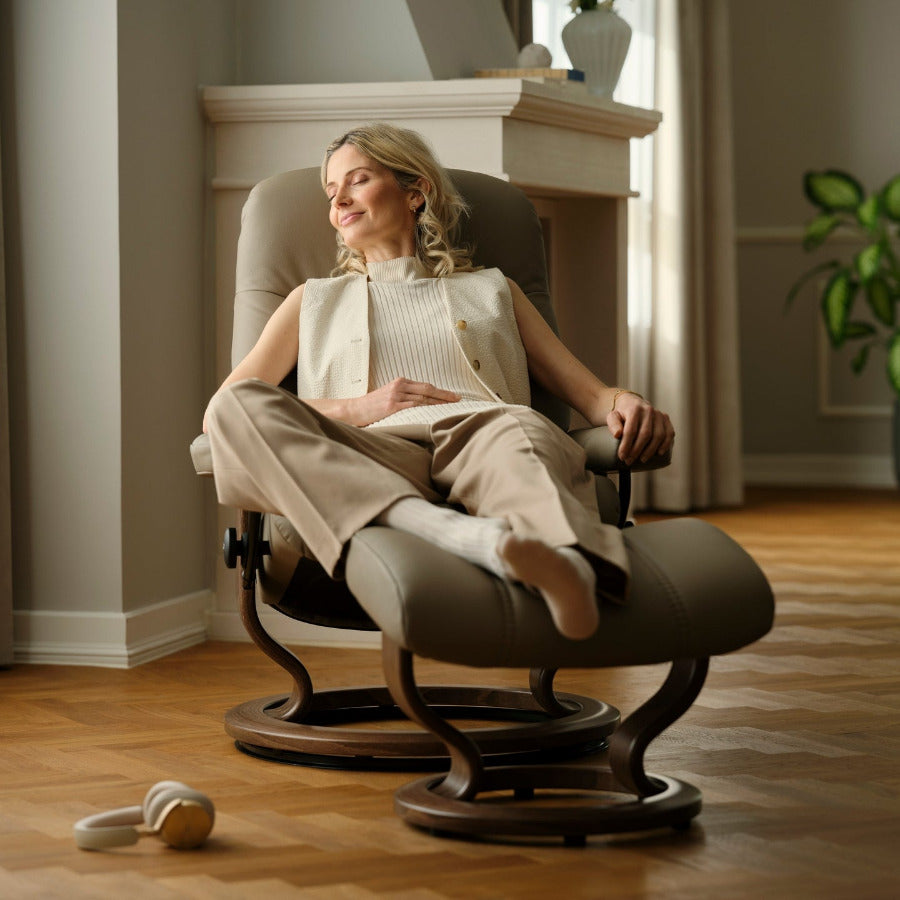
Engineered for Your Body
The right ergonomic chair doesn’t just feel good for 10 minutes—it supports your body correctly for hours, years, and decades.
We’ve been selling and servicing Stressless recliners for decades. A well-built chair with replaceable parts can genuinely last 20+ years. Come sit in every size and feel the difference.
Our Picks
Brands to Explore
Stressless / Ekornes
Ergonomic comfort engineering with patented motion features like the Glide system. Less about ‘puffy soft’ and more about engineered support that moves with you. 10-year guarantee on internal mechanism and framework.
Best for: ergonomic recliners, people with back/neck support needs, small/medium/large sizing buyers.
Explore StresslessSmith Brothers of Berne
American-made custom upholstery with quality component sourcing. Offers both stationary and motion categories with hardwood maple frames, steel coil springs, and high-quality foam. A ‘custom comfort’ line with solid bones and lots of choice.
Best for: custom sofas and motion seating, mid-to-high-end upholstered seating, buyers who want lots of fabric choices.
Shop Smith BrothersShould I buy a recliner, a stationary chair, or a motion sofa?
If you prioritize posture support and long sit sessions, motion can be a game-changer; if you want a ‘showpiece’ look, stationary often wins.
What to Know
- Motion seating is best for reading/TV and back support; stationary is often cleaner in silhouette.
- Check wall clearance requirements for motion pieces and confirm power access for powered models.
- Try multiple sizes when offered—fit matters as much as feature set.
- Ask about mechanism warranty and serviceability.
Braden’s Take: We’ll set you up with side-by-side comparisons—recliner vs. motion sofa vs. stationary—so you can feel the difference rather than just read about it. What works depends on your room layout and how you actually sit.
Brands to explore: Stressless / Ekornes, Smith Brothers of Berne
How long should good furniture last?
With solid construction and normal use, quality upholstery often lasts 10–20 years; quality wood casegoods can be multi-generational.
What to Know
- Upholstery life is driven by frame, support system, and cushion materials—not just the fabric.
- Wood furniture longevity is driven by joinery, wood movement allowances, and finish quality.
- If you expect to keep it 10+ years, prioritize structure and replaceable/repairable components.
- Ask about warranty coverage for frame, suspension, and mechanisms (especially for motion seating).
Braden’s Take: We’ve been selling Stressless recliners for decades and servicing them locally. A well-built chair with replaceable parts can genuinely last 20+ years. Ask us about the pieces we’ve seen come back for re-covering—still structurally perfect.
Brands to explore: Stickley, Stressless / Ekornes
How do I know if a recliner fits me without committing?
The only real test is sitting in it—for more than a minute—in the positions you actually use at home.
What to Know
- Spend at least 10 minutes. Sit how you actually sit: reading, watching TV, resting with eyes closed. Two minutes standing in a showroom aisle tells you almost nothing.
- Try multiple sizes if the brand offers them. The difference between a medium and large Stressless is immediately obvious when you sit in both.
- Check lumbar contact, headrest height, seat depth, and whether your feet rest flat. All four need to work, not just comfort feel.
- Bring your partner if you’re both using it—different bodies often need different sizes or models.
Braden’s Take: Our Knoxville and Maryville showrooms have every Stressless size on the floor. We’ll measure you, recommend a starting size, and give you all the time you need to compare.
Brands to explore: Stressless / Ekornes
Ready for a Fit Test?
The best way to find the right ergonomic chair is to sit in it—for more than a minute. Visit our showroom and we’ll measure you, recommend a starting size, and give you time to compare models back to back. No rushing, no pressure.

Est in 1956
With nearly seven decades of experience, we’ve built our name on craftsmanship, care, and a deep understanding of what makes a house feel like home.

Designed for Life
We choose every piece for its lasting quality, timeless style, and ability to bring comfort and character to everyday living.

People first, always
From the way we design to the way we serve, we put people at the heart of everything we do.